
www.HealthyHearing.com |
Can cognitive behavior therapy help with my tinnitus?Reframing thoughts to manage emotoinsKey points:
While there’s no cure for tinnitus, there are several potential treatments. For people who have tinnitus accompanied by hearing loss, which is very common, hearing aids can be very helpful, as today's hearing aids even come with tinnitus maskers. For anyone, though, counseling—and in particular, cognitive behavioral therapy (CBT)—is another potential strategy to help people manage tinnitus. Let's take a look at how CBT may help:
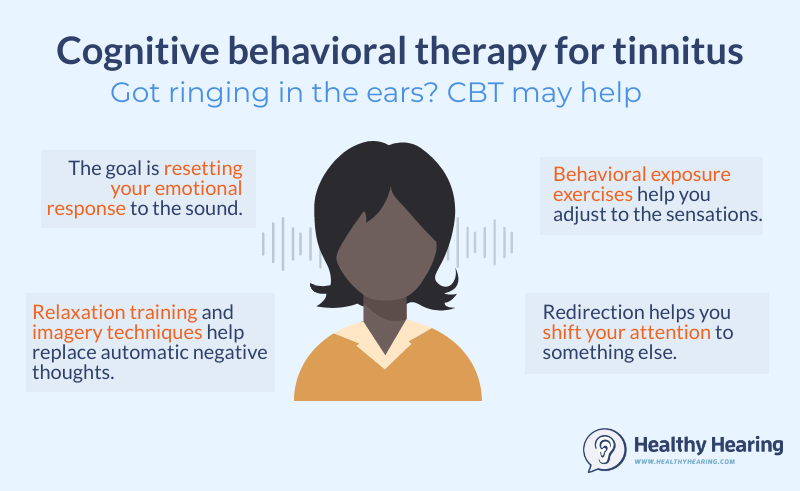
Why consider CBT for tinnitus?With this therapeutic technique, people learn to adjust their reaction and response to tinnitus. It's not about making the sound go away, but accepting and managing it. “We can change how we tolerate physical sensations, particularly if they are aversive and causing any anxiety,” says psychologist Johanna Kaplan, PhD, the director of Washington Anxiety Center of Capitol Hill. That is, if you embark on cognitive-behavior therapy, the goal isn’t to cure your tinnitus—but to change how you respond to the symptom. No big deal versus deeply upsetting“Someone suffering may think, I cannot do this anymore or will this be my life from now on? We combat this catastrophic-type thinking with cognitive restructuring techniques meant to reduce anxiety caused by these thoughts,” Kaplan explains. As the American Tinnitus Association (ATA) puts it, the difference between seeing tinnitus as “no big deal” or “deeply upsetting” rests in the emotional response to the sounds, not the sounds themselves. There are other key ways CBT can be helpful, Kaplan says:
People often get relaxation training and discover imagery techniques through CBT, according to an article in the Korean Journal of Audiology. This type of therapy is short-term, not ongoing. Some people experience relief within two months, Kaplan says. It’s common to have up to six months of weekly sessions, she says. What the research showsResearch points to CBT as being an effective strategy when it comes to tinnitus. In a 2010 review examining randomized controlled trials, for instance, researchers found participants had improved quality of life if they had CBT, compared to participants with no treatment or other interventions, such as yoga. And, a 2014 review of studies published in the Journal of the American Academy of Audiology found that “CBT treatment for tinnitus management is the most evidence-based treatment option so far.” Other behavioral treatmentsBut of course, CBT isn’t a cure-all. “One has to remember it is likely not a panacea,” Kaplan says. Nor is it the only strategy out there. Other behavioral treatments, according to the ATA, include:
Where to find behavioral help for tinnitusThere are many places to find a therapist—your doctor or health care provider may be able to make a referral. Listing services, such as Psychology Today or GoodTherapy, are another good place to find someone. “Usually any willing CBT therapist can help,” Kaplan says. “You have to have someone well-trained in the model, but the techniques are the same and can be applied to develop an individually-based treatment.” Madeleine Burry
|
Hearing centers close to me:
| Ohio State Univ Hearing |
| Nationwide Childrens Hospital |
| Ohio State University Audiology Clinic |
| Columbus Speech & Hearing Center |
Find hearing clinics in my country:


 Madeleine Burry is a Brooklyn-based freelance writer and editor. She's written about health for several online publications, including Women's Health, Prevention, Health, Livestrong and Good Housekeeping. You can follow her on Twitter @lovelanewest.