
www.HealthyHearing.com |
Can older adults get cochlear implants?Good news: Age shouldn't be a barrier, experts sayKey points:
Hearing loss is common among older adults. According to the National Institute on Deafness and Other Communication Disorders (NIDCD), more than half of American adults 75+ have hearing loss. While hearing aids work well for many seniors, they are not always strong enough for those with severe to profound hearing loss. Fortunately, cochlear implants can provide another suitable option for people of all ages. What are cochlear implants?Cochlear implants are small devices surgically implanted in your ear. They stimulate the auditory nerve directly with electrical currents via electrodes in a wire. These electrodes bypass damaged inner ear sensory cells and provide information to the brain that can improve speech perception.
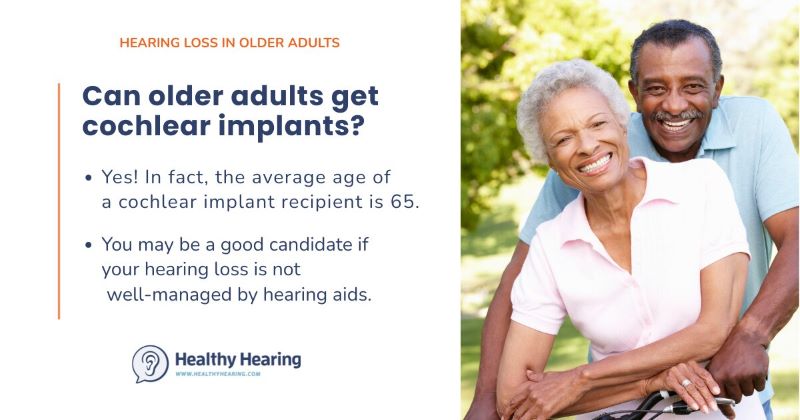
Not just for kidsCochlear implants were once offered mainly to deaf or near-deaf children. But research shows that adults can benefit as well. In fact, the average age of cochlear implant recipients is 65, according to manufacturer Cochlear. Age shouldn’t be a factor in your decision, according to a 2020 global consensus report from 31 hearing experts. Bottom line: Older adults can benefit from cochlear implants as much as kids or younger adults. If you have hearing aids and don't feel satisfied with how you're hearing, you may want to ask about cochlear implants. What are the guidelines for cochlear implants for seniors?You'll want to talk to your doctor for specifics, but in general, a cochlear implant may be a good option if:
However, your doctors may or may not recommend an implant in other circumstances. Can Medicare pay for a cochlear implant?Yes! Unlike hearing aids, a cochlear implant is covered by Medicare if you recognize sentences with your hearing aids only 40 percent of the time or less. If you score between 40 and 60 percent, you may be eligible if your provider is participating in a clinical trial. You may also have coverage from Medicaid (with some variation by state) and many private insurance carriers. Coverage for aural rehab may be limited, but you can ask your provider to argue on your behalf. What happens during cochlear implant surgery?Read our in-depth overview piece on cochlear implants to learn about the typical process for getting a cochlear implant, including the surgical steps, and a breakdown of the different parts of a cochlear implant. Will I get one or two implants?This will vary depending on your circumstances, but you'll likely start out with receiving one implant. It's typically implanted into the ear that has worse hearing. You can still wear a hearing aid in the other ear (this is known as "bimodal hearing"), or eventually get a second surgery for another implant, if warranted. What will my hearing be like with a cochlear implant?The potential benefits of a cochlear implant vary from person to person. For a complete list of benefits and risks, visit the FDA’s full overview. In general, many cochlear implant recipients experience:
Most adults notice improvements right after their implant is activated, with steady progress over the first few months. Many continue to improve over time as their brain adapts to the new sound input. Because outcomes can range from significant benefit to limited improvement, it’s important to talk with your hearing specialist about realistic expectations and what your hopes and goals for treatment are. Adapting to a cochlear implant as an older adultAdjusting to your cochlear implant can take a bit of time, and certain noises may sound different than you remember. You will likely have several visits with an audiologist to help you adjust. “As you lose your hearing, your brain is changing, adapting to the limited information you’re getting,” explains Dr. Buchman. “What you’re used to is degraded. By three months, the vast majority of people are having good speech understanding and awareness. The brain takes the information and clarifies it.” 'Rehab' for your ears is recommendedYou’ll need three or four programming sessions to fine-tune your device for your needs. You’ll also consult with specialists to see how much help you need with speaking and understanding sounds. A standard “auditory rehab” program might be 6 to 10 sessions weekly, or as needed. You may find that you are better able to control how loudly you speak and can understand speech more clearly. Who performs the surgery?Surgeons known as neurotologists or otologists specialize in this kind of delicate ear surgery. You may first need to see a primary care doctor for a referral to a specialist. Be sure to check with your insurance provider to find a provider in your network. Our directory of hearing care professionals includes many ENT offices and may be a good place to start, too. It's important to remember that you’re never too old to take steps toward better hearing. If traditional hearing aids are no longer giving you the clarity you need, it may be time to talk with your provider about whether a cochlear implant could be an option. Joy Victory, managing editor, Healthy Hearing
|
Hearing centers close to me:
| Ohio State Univ Hearing |
| Nationwide Childrens Hospital |
| Ohio State University Audiology Clinic |
| Columbus Speech & Hearing Center |
Find hearing clinics in my country:


 Joy Victory has extensive experience editing consumer health information. Her training in particular has focused on how to best communicate evidence-based medical guidelines and clinical trial results to the public. She strives to make health content accurate, accessible and engaging to the public.